Table of contents
- Why is it necessary to measure employee performance?
- 5 reasons to measure employee performance
- Which methods should you use to measure employee performance?
- How to measure employee performance, step by step
- When performance measurement does more harm than good
- How Responsly supports employee performance measurement
- Summary

Measuring employee performance means comparing what people deliver, and how they deliver it, against expectations agreed in advance, using a mix of goals, structured feedback and a few role-specific metrics. This guide is for HR leads and managers who need to explain why that is worth the effort, and then do it without turning it into surveillance. Below are the five reasons that hold up in practice, each with what goes wrong without measurement, what to measure and a short scenario. After that come six methods compared side by side, a step-by-step rollout with outcome and behaviour metrics for different roles, and the honest limits of employee performance measurement, from Goodhart’s law to rater bias, including when a metric should never be tied to pay.
Why is it necessary to measure employee performance?
Because decisions about people get made anyway. Without measurement, pay, promotions, coaching and workload are decided on memory, visibility and whoever speaks up most. Measuring employee performance replaces that with agreed expectations and evidence, so employees know what good looks like, managers coach earlier, and the organisation can see whether its people strategy is working.
The necessity is rarely in question. The method is. According to Gallup, only 14% of employees strongly agree that their performance reviews inspire them to improve. That is not an argument against measuring. It is an argument against measuring once a year, with a single rater, and calling the result a conversation.
5 reasons to measure employee performance
Each reason below holds only when measurement is frequent, specific and clearly separated from monitoring people’s activity.
1. It turns growth and development into a plan
What goes wrong without it. Feedback stays at “keep doing what you are doing”, development budget goes to whoever asks first, and people who want to grow learn from a recruiter that they could. Those most likely to leave over invisible progress are the ones you most want to keep.
What to measure. The gap between current skills and the next role’s expectations, progress on one to three development goals per quarter, and whether the employee can describe their next step. That last one is a survey question you can track over time.
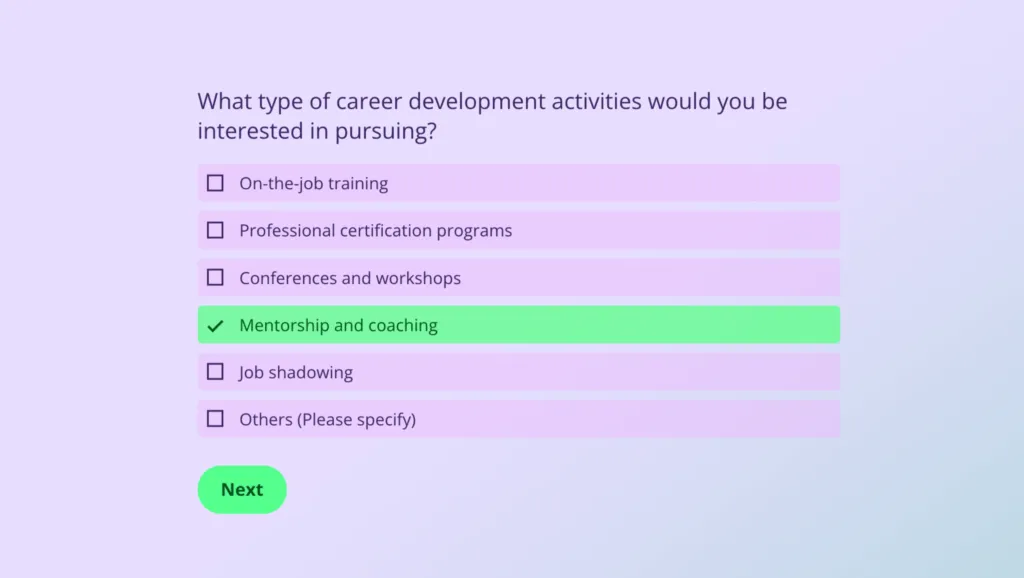
Scenario. A B2B SaaS company has senior engineers who want to grow, but not into management. Without measurement, every review ends with “great work”. With a skills matrix for a staff-engineer path and a short survey before quarterly check-ins, the manager learns that most of them want mentoring and stretch projects rather than another course.
The career development survey template covers growth clarity, learning access, manager coaching and internal mobility, a reasonable starting set for this check.
2. It keeps motivation tied to fair, visible recognition
What goes wrong without it. Recognition follows visibility. The person who presents the result gets the credit, the people who made it possible do not, and effort nobody sees stops being offered. Inconsistency makes it worse: one manager praises weekly, another never.
What to measure. Outcomes and collaboration behaviours together, how often people receive specific feedback, and whether they believe recognition is fair. “When I do good work, it is noticed” reads very differently split by role and team.
Scenario. In a services firm, account leads present results to clients and collect the praise, while delivery specialists do much of the work. A recognition question in the quarterly pulse shows a split by role: client-facing staff agree, delivery staff do not. That is a pattern in how the firm recognises work, not a problem with one person.
Frequency matters. In the same Gallup analysis, team members whose managers give weekly rather than annual feedback were 3.2 times more likely to strongly agree that they are motivated to do outstanding work.
3. It exposes problems that are not the employee’s fault
What goes wrong without it. Broken tools, unclear handoffs and overloaded queues show up as individual underperformance, and the fix becomes a performance plan for someone who could not have done better in that system.
What to measure. Recurring blockers in open-ended answers, workload, time lost to tools and process, and patterns by team, role and manager rather than by individual.
Scenario. A support team’s resolution times climb for two months, and the individual numbers point at the newest agents. Open-ended answers in an anonymous survey say otherwise: the knowledge base was not updated after a product release, so every agent escalates the same questions. Fix the knowledge base, not the people.
The employee satisfaction survey template measures satisfaction with role, manager support, workload and growth opportunities; its open-ended questions are where blockers like this surface.
4. It connects individual work to company performance
What goes wrong without it. Teams set targets separately, hit them, and the company still misses its objectives because the targets never added up. Employee performance measurement is where you find out whether they do.
What to measure. The share of individual and team goals that trace back to a company objective, team outcomes such as retained revenue, activation or on-time delivery, and brief context on the trade-offs made.
Scenario. A SaaS product team ships every planned feature in a quarter, so its goals are met. Meanwhile customer success sees renewals stall, because onboarding friction was on nobody’s goal list. A joint quarterly goal review would have shown that nothing on the roadmap was measured against activation.
5. It makes people decisions fair and defensible
What goes wrong without it. Promotions, transfers and exits are decided from memory, which overweights the last few weeks and the most visible people. When a decision is challenged, there is nothing to show but an opinion.
What to measure. Goal attainment over several periods, notes from regular check-ins, multi-rater input where collaboration is the job, and how consistently different managers rate comparable work.
Scenario. An HR team prepares a promotion round with two candidates for a team lead role. One manager rates everyone higher than their peers do. With goal history and structured input from peers and direct reports, calibration becomes a discussion of evidence instead of advocacy. Our guide to the 360-degree review process covers running that cycle from rater selection to the follow-up conversation.
Which methods should you use to measure employee performance?
Use goals or KPIs for outcomes, manager reviews for judgement and context, and multi-rater feedback where collaboration is the job. Add self-assessment to start the conversation, and pulse surveys to measure the conditions people work in. No single method covers outcomes, behaviours and context, so most teams combine two or three.
| Method | What it measures | Best for | Watch out for |
|---|---|---|---|
| Goals / OKRs and KPIs | Outcomes against agreed targets | Roles with clear, controllable output: sales, support, delivery | Targets the person cannot influence; gaming once a target is tied to pay |
| Manager review | Overall contribution, judgement and the context behind the numbers | Every role; the anchor of a performance review | One rater’s bias, recency, managers who rate consistently high or low |
| 360 feedback | Behaviours as seen by the manager, peers, direct reports and the employee | Leaders, managers and collaboration-heavy roles | Time and rater fatigue; works best for development, not pay |
| Self-assessment | The employee’s view of results, strengths and blockers | Preparing check-ins, surfacing context the manager missed | Reflects confidence as much as performance; never use it alone |
| Peer feedback | Collaboration, reliability, knowledge sharing | Project and cross-functional teams | Friendship and rivalry effects; needs specific, behavioural questions |
| Pulse / engagement surveys | Conditions of work: clarity, workload, recognition, loyalty | Team and organisation trends | Measures teams, not individuals; anonymity has to be protected |
Read the last row carefully. Pulse and engagement surveys, including eNPS, describe the environment a team works in, not any one person’s performance. They explain why a team’s results move, so they complement the other five methods rather than replace them. If you are choosing software for that layer, see our comparison of employee pulse survey tools.
How to measure employee performance, step by step
Start smaller than you think you need to. A rollout that measures three things well beats one that measures twelve things nobody trusts.
- Decide what the measurement is for. Development, pay decisions, or both. If both, hold them in separate conversations, or development turns into a negotiation.
- Define outcomes and behaviours for each role. Two or three outcome metrics and two or three behaviours per role family is enough to begin (see the table below).
- Pick two or three methods. A typical starting point is goals plus regular manager check-ins, with 360 feedback added for people leaders.
- Set a cadence people can keep. Check-ins every week or two, goal reviews quarterly, 360 feedback once or twice a year, pulse surveys monthly or quarterly. A schedule that slips by the second cycle tells people the process is optional.
- Train managers and calibrate. Agree what each rating level means, with examples, and compare ratings across managers before decisions rest on them.
- Tell people what you measure, who sees it and what it is used for. Write it down. Ambiguity here is what makes measurement feel like surveillance.
- Pilot, then prune. Run one full cycle with one or two teams. Afterwards, remove every metric that did not inform a decision or a conversation.
What to measure for different roles
| Role | Outcome metrics | Behaviour metrics | Avoid as a headline metric |
|---|---|---|---|
| Sales and account management | Revenue against target, win rate, retained revenue | Forecast accuracy, quality of handover to customer success | Calls or emails sent |
| Customer support | Resolution rate, customer satisfaction on resolved tickets, reopen rate | Knowledge base contributions, help on escalations | Tickets closed per hour on its own |
| Software engineering | Roadmap goals delivered, production incidents, team cycle time | Code review quality, documentation, mentoring | Lines of code or commits |
| Customer success and services | Renewals, projects delivered on time and on budget, client feedback | Early risk flags, collaboration with other teams | Hours logged |
| HR and People teams | Time to fill, onboarding completion, follow-through on survey actions | Partnership with managers, quality of action plans | Number of initiatives launched |
| People managers | Team outcomes, retention, team engagement trend | Coaching frequency and feedback quality, as rated by direct reports | Their own individual output |
Outcome metrics say what was achieved. Behaviour metrics say how, and predict whether it will happen again. Roles with short, controllable cycles, such as sales and support, can lean on outcomes. Roles where results are long-cycle or shared, such as engineering and management, need more weight on behaviours, because an individual’s outcome is hard to separate from the team’s.
When performance measurement does more harm than good
Employee performance measurement has known failure modes. Check for these before you launch, and again after the first cycle.
Measuring activity instead of outcomes. Hours online, calls made, tickets touched and lines of code are easy to count and almost always the wrong thing to reward. They measure being busy, and penalise the person who solves a problem in one step instead of five.
Goodhart’s law. Named after the economist Charles Goodhart, it is usually paraphrased as “when a measure becomes a target, it ceases to be a good measure.” Target a support team on handle time and tickets close faster, then reopen. Pair every quantity metric with a quality metric, and keep some measures diagnostic only, never targeted.
Rater bias. Ratings describe raters more than most people expect. In a Journal of Applied Psychology study, Scullen, Mount and Goff (2000) analysed two large data sets of managers rated by bosses, peers, direct reports and themselves. Raters’ idiosyncrasies explained more than half of the variance in ratings in both, up to 62%, while differences in the managers’ own performance explained 21% to 25%. It is one of the findings Deloitte cited when it redesigned its performance management. Multiple raters, behaviour-specific questions and calibration reduce the problem without removing it, so treat any single rating as one data point.
Forced ranking. Ranking people on a fixed curve assumes every team has the same spread of performance. Small teams do not, strong teams lose a good person to the quota, and colleagues learn that helping each other moves them down the list. Differentiate on evidence, not on a predetermined distribution.
Surveys used as surveillance. Engagement and pulse surveys work because people believe their answers cannot be traced. The first time a manager tries to work out who wrote a comment, or uses survey results to rate an individual, candour drops and you lose your most honest channel. Report at team level with minimum response thresholds, and read our guide to anonymous employee feedback before you design the programme.
When not to tie a metric to pay
Pay is a blunt instrument even when it is well designed: in the Gallup analysis cited above, only 22% of employees strongly agreed that their pay and incentives motivate them to do what is best for their organisation. Keep a metric out of compensation when:
- The employee cannot control it, such as company revenue for a junior role, or a number that depends on another team.
- It is easy to game without improving the work, which covers most activity counts.
- It comes from developmental feedback. Once raters know a 360 or peer review moves someone’s pay, they rate differently, and the feedback stops being useful for development.
- It comes from an anonymous survey. Always.
- It is new, and nobody knows yet what a normal range looks like.
- The work is collaborative and individual attribution would be guesswork.
How Responsly supports employee performance measurement
Responsly is a feedback and survey platform, so it covers the feedback side of employee performance measurement: multi-rater reviews, employee surveys and analysis of what people write.
- 360 feedback. Responsly 360 feedback collects structured input from managers, peers, direct reports and a self-assessment. You start from a 360 feedback form template, design custom competencies that reflect your organisation’s values, choose evaluator, manager and subject options, and let automated distribution and reminders keep the cycle moving.
- Employee survey templates. Besides the career development and employee satisfaction surveys above, the library includes recognition and supervisor evaluation (upward feedback) surveys, all editable before sending.
- HR programmes. Responsly for HR teams runs pulse, eNPS and engagement programmes on one platform. Minimum response thresholds keep small teams unidentifiable, and manager dashboards show aggregated team views with configurable access rules.
- Open-ended analysis. Athena, Responsly’s AI agent, groups open-ended answers into themes nobody had to define upfront and gives every comment a sentiment score, so recurring blockers surface as named problems. Names, emails and phone numbers are stripped from open-text answers before analysis.
Where it is not the right tool: goal cascades, OKR tracking and compensation workflows are a job for a performance management system or HRIS. Responsly sits next to it and supplies the feedback those decisions should rest on.
Summary
It is necessary to measure employee performance because people decisions are made either way, and evidence makes them fairer than memory. The five reasons are growth, motivation, finding system problems, connecting individual work to company results, and defensible decisions. Each depends on measuring outcomes and behaviours, not activity.
Combine two or three methods, start with one team, say exactly what you measure, and keep developmental feedback and anonymous surveys away from pay.
To start on the feedback side, create a free Responsly account and launch your first employee survey from a template.
FAQ
What is the best way to measure employee performance?
How often should employee performance be measured?
What is the difference between outcome and behaviour metrics?
Should performance ratings be tied to pay?
Is a 360 review the same as a performance review?
How do you measure performance without micromanaging?
Tagged in
Last updated