Table of contents
- What are customer service survey questions?
- Why customer service survey questions matter
- The 3 metrics every customer service survey should track
- Key customer service survey questions to include
- Customer service survey questions by channel
- Customer service questionnaire example (template)
- Question types that get more responses
- Customer service satisfaction survey best practices
- How to analyze customer service survey results with Responsly
- Conclusion
Customer service survey questions are the specific questions you ask after a support interaction to measure how satisfied, loyal, and effortless that experience was. This guide is for support leaders, CX managers, and small teams who want feedback they can act on—not vanity metrics. You’ll get the three core metrics every service survey should track (CSAT, NPS, and CES), copy-ready customer service survey questions for phone, live chat, email, and self-service, a ready-to-use customer service questionnaire, the question types that lift completion rates, and best practices for timing and follow-up. Whether you run a busy help desk or a single support inbox, the right questions turn raw feedback into a clear plan for better service.
What are customer service survey questions?
Customer service survey questions are structured prompts sent right after a support touchpoint—a call, chat, email, or self-service session—to capture how the customer felt about the help they received. They combine short rating questions (for scale and benchmarking) with one open-ended question (for context), so you can quantify performance and understand the “why” behind the score.
The best questions are tied to a specific metric and a specific moment. A generic “How did we do?” tells you little; “How easy was it to resolve your issue today?” tells you exactly where friction lives. Good survey question design keeps them clear, unbiased, and quick to answer.
Why customer service survey questions matter
Customer service surveys allow businesses to:
- Measure satisfaction: Understand how well your team meets customer expectations at each interaction.
- Identify pain points: Pinpoint the channels, agents, or processes where service breaks down.
- Foster loyalty: Show customers that their feedback matters, which builds trust and lifts retention.
- Drive continuous improvement: Feed a closed feedback loop so data turns into concrete process changes.
Support is one of the most feedback-rich functions in any company—every ticket is a chance to learn. The teams that win treat these signals as an operational input, tracked over time with clear customer service metrics.
The 3 metrics every customer service survey should track
Most effective service surveys are built from three complementary metrics. Each answers a different question, so use them together rather than picking just one.
| Metric | What it measures | Question example | When to send |
|---|---|---|---|
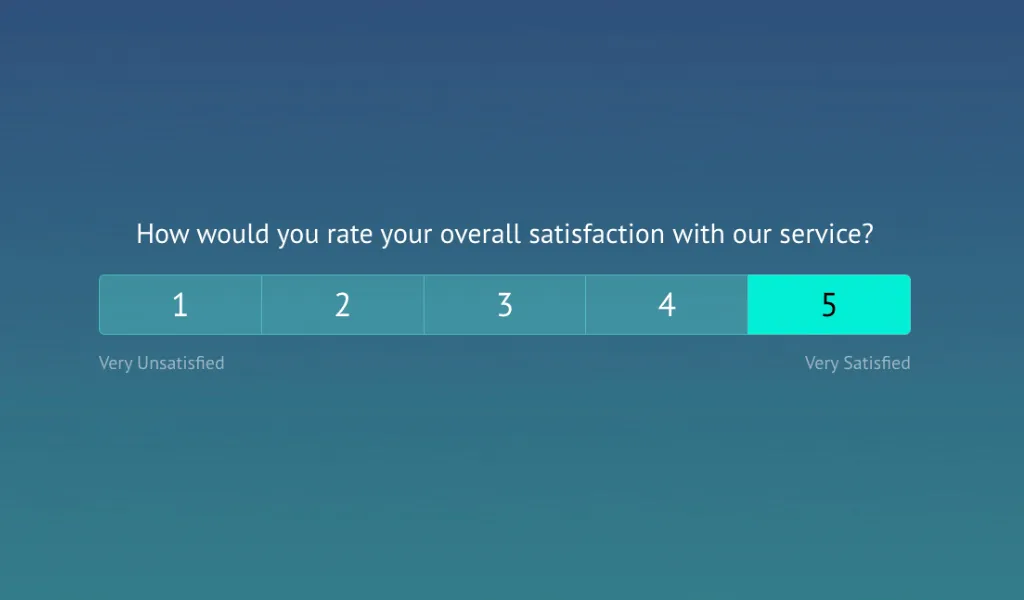
| CSAT | Satisfaction with this specific interaction | ”How satisfied were you with our service today?” (1-5) | Right after the ticket, call, or chat |
| NPS | Overall loyalty and likelihood to recommend | ”How likely are you to recommend us?” (0-10) | Periodically, or after a resolved relationship touchpoint |
| CES | How much effort the customer had to spend | ”How easy was it to get the help you needed?” (very easy–very difficult) | Immediately after a support task |
Rule of thumb: use CSAT and CES on transactional post-support surveys (they map directly to a single interaction), and reserve NPS for relationship surveys where the customer has enough experience to judge loyalty.
Key customer service survey questions to include
1. How satisfied were you with our service today?
Why it matters: This classic Customer Satisfaction Score (CSAT) question provides immediate insight into customer happiness and flags interactions that need follow-up.
Pro tip: Use a 1-5 or 1-10 scale so respondents can answer in a single tap. See our guide to measuring customer satisfaction and the best customer satisfaction survey questions.
2. How likely are you to recommend our service to a friend or colleague?
Why it matters: This Net Promoter Score (NPS) question gauges loyalty and advocacy beyond a single ticket.
Pro tip: Always follow up with “What’s the main reason for your score?” to make the number actionable. Learn more about running better NPS surveys.
3. Was your issue resolved to your satisfaction?
Why it matters: Resolution is the core job of support. This yes/no question measures effectiveness and surfaces tickets that were closed but not truly solved.
Pro tip: Pair it with a conditional open-ended field (“If not, please explain why”). For difficult cases, see how to handle customer complaints and run service recovery.
4. How easy was it to get the help you needed?
Why it matters: This Customer Effort Score (CES) question identifies friction—long waits, repeated explanations, or channel switching—that quietly erodes loyalty.
Pro tip: Use a labeled scale from “very easy” to “very difficult.” Start from the CES survey template to measure effort consistently.
5. How can we improve your experience?
Why it matters: One open-ended question is a goldmine of qualitative detail that scores alone can’t provide—naming the specific problem, agent, or step.
Pro tip: Theme the recurring answers instead of reading them one by one. For more, read how to collect and act on customer feedback and the wider set of open-ended questions.
Customer service survey questions by channel
Different support channels create different experiences, so tailor the questions to the moment. Below are copy-ready examples for the four most common touchpoints.
Phone / call center survey questions
Ask these immediately after the call ends (via SMS or email):
- How satisfied were you with the support you received on this call? (1-5)
- Was your issue resolved during the call? (Yes / Partially / No)
- How would you rate the agent’s knowledge and professionalism? (1-5)
- How long did you wait before reaching an agent? (multiple choice ranges)
Live chat survey questions (and post-chat survey questions)
Post-chat surveys must be ultra-short so they fit in the chat window. Fire them the moment the conversation closes:
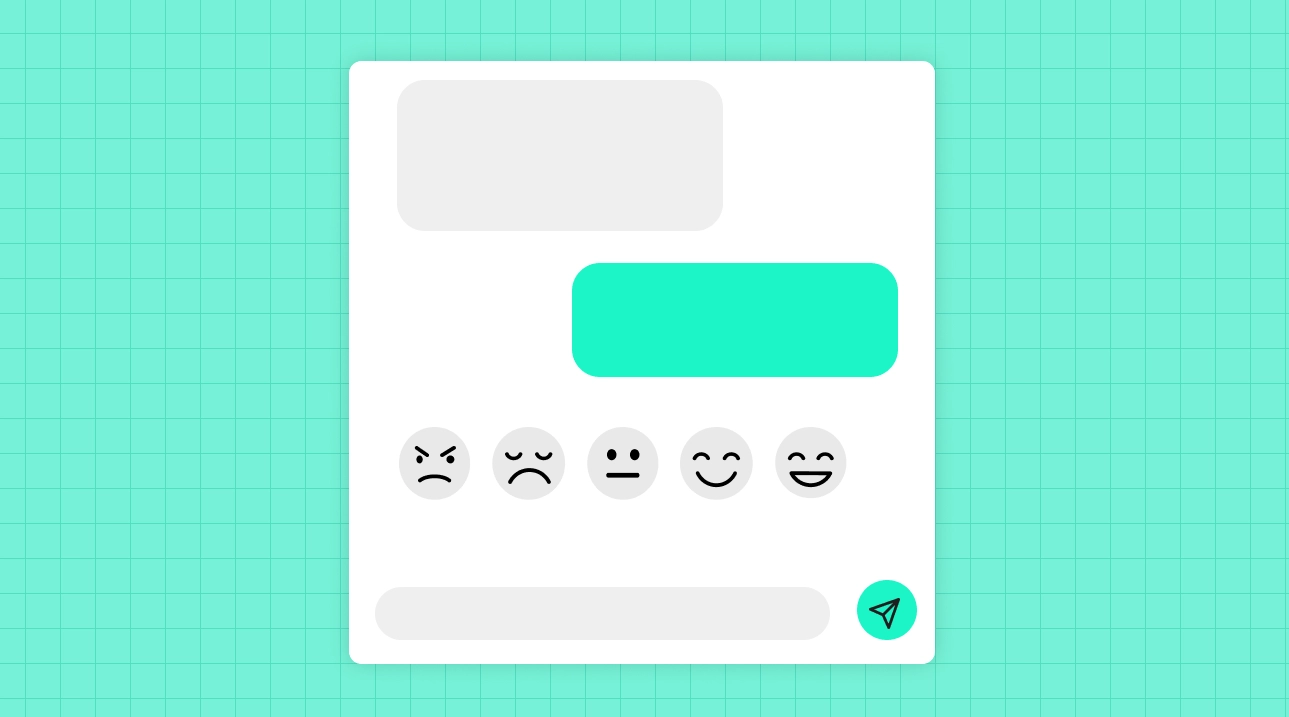
- How satisfied were you with this chat? (smiley or 1-5 scale)
- How easy was it to get the help you needed? (CES)
- Was your issue resolved in this chat? (Yes / No)
- Anything the agent could have done better? (optional open text)
Live chat and post-chat survey questions work best embedded directly in the chat widget, so the customer never has to leave the conversation to answer.
Email support survey questions
Attach a one-click rating to the “ticket resolved” email:
- How satisfied were you with how we handled your request? (1-5)
- Did our reply fully answer your question? (Yes / Partially / No)
- How many replies did it take to resolve your issue? (1 / 2 / 3+)
You can embed the first question straight into the message—see our guide to the customer feedback email and distribute at scale with email surveys.
Self-service and help center survey questions
Measure whether your knowledge base actually deflects tickets:
- Was this article helpful? (Yes / No)
- How easy was it to find what you were looking for? (CES)
- What were you trying to do? (open text)
Deploy these as unobtrusive website surveys or microsurveys on help pages.
Customer service questionnaire example (template)
If you need a ready-made customer service questionnaire, keep it to four core questions plus one open field. This structure covers satisfaction, effort, resolution, and improvement without causing survey fatigue.
- CSAT: How satisfied were you with our service today? (1-5)
- CES: How easy was it to get the help you needed? (very easy–very difficult)
- Resolution: Was your issue fully resolved? (Yes / Partially / No)
- Agent quality: How would you rate the person who helped you? (1-5)
- Open text: How can we improve your experience? (optional)
You can launch a version of this in minutes with the customer satisfaction survey template, or browse the full library of customer feedback templates for more starting points.
Question types that get more responses
The format you choose affects both completion rate and data quality:
- Rating scales (1-5, 1-10): fast, easy to benchmark, ideal for CSAT.
- Smiley / emoji ratings: the lowest-friction option, great for live chat and mobile.
- Labeled scales: best for CES (“very easy” to “very difficult”).
- Multiple choice questions: good for wait times, contact reasons, or channel used.
- Open-ended questions: one per survey, for the “why” behind the score.
For the trade-offs between formats, see our overview of survey question types.
Customer service satisfaction survey best practices
- Keep it short. Limit transactional surveys to 1-3 questions plus one optional open field—respect your customers’ time.
- Send it while it’s fresh. Trigger the survey immediately after the interaction (ticket closed, call ended, chat resolved).
- Make it mobile-friendly. Most customers answer surveys on their phones, so use large tap targets and a single-column layout.
- Personalize it. Reference the customer’s name and the specific interaction so the request feels relevant, not mass-blasted.
- Always include one open-ended question. The number tells you what; the comment tells you why.
- Close the loop. Route low scores to the right person and follow up—a visible closed feedback loop turns detractors into repeat customers.
- Test before you launch. Run a quick trial to catch confusing wording and broken logic.
How to analyze customer service survey results with Responsly
Collecting answers is only half the job—acting on them is where the value is. Responsly for CX teams is an AI-powered customer feedback platform that helps you run the whole loop:
- Ask on any channel. Distribute the same survey across email, SMS, WhatsApp, and website so you reach customers where the interaction happened.
- Analyze open text automatically. Athena, Responsly’s AI agent, clusters open-ended answers into themes, scores sentiment, and flags at-risk customers—so hundreds of “how can we improve” replies become a ranked list of fixes in your feedback analytics.
- Track CSAT, NPS, and CES in one place. Watch trends over time and segment by channel, agent, or product line.
- Close the loop and act. Get alerted to negative feedback instantly, follow up, and tell customers what changed.
Teams at Red Bull, DB Schenker, and Schneider Electric use Responsly to collect and act on this kind of feedback. Start from the customer satisfaction survey template or create a free Responsly account to launch your first customer service survey today.
Conclusion
Thoughtful customer service survey questions are the foundation of a support operation that improves instead of guessing. Anchor every survey to a clear metric—CSAT for satisfaction, CES for effort, NPS for loyalty—tailor the wording to the channel, keep it short, and always leave room for one open comment. Then act on what you learn and close the loop. Do that consistently and your surveys won’t just measure service quality; they’ll steadily raise it.
For more resources, explore our customer feedback survey templates and the guide to improving customer service.
FAQ
What are the 3 most important customer service questions?
How many questions should a post-support survey have?
Should I use open-ended questions?
When is the best time to send a service survey?
What questions should a customer service questionnaire include?
What are good live chat survey questions?
Tagged in
Last updated