Table of contents
- What is a market research survey?
- Why market research surveys matter (and what changed)
- Types of market research surveys
- Market survey techniques
- What you can measure with market research surveys
- Market research survey examples and questions
- Market research survey for a new product
- Market research survey for a new business
- How to conduct a market research survey: 6 steps
- Advantages and limitations of market research surveys
- Market research survey templates
- How to run market research surveys with Responsly
- Conclusion
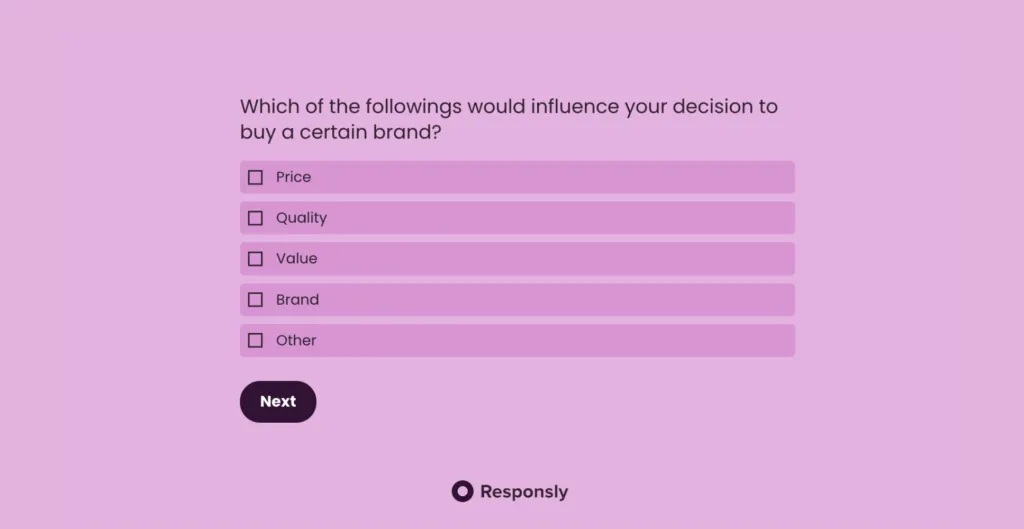
A market research survey is a structured questionnaire used to collect data about a market, its customers, and competitors—so you can make decisions about products, pricing, positioning, and marketing based on evidence instead of assumptions. This guide is for marketers, founders, and in-house research teams who need reliable market insight without an expensive agency. You’ll get a clear definition, the main market research survey types (with a decision framework), proven techniques, example questions, ready-to-use templates, and how to run and analyze it all with AI—optionally syncing responses through research and customer experience integrations. If you also want help structuring the questionnaire itself, start with our survey design guide.
What is a market research survey?
A market research survey is a method of primary research—you collect first-party data directly from a target audience rather than relying on secondary reports. It is mostly quantitative (countable, comparable answers), but it can include open-ended questions for qualitative depth. In practice, it is the fastest, most cost-effective way to answer a specific business question: Will people buy this? At what price? How is our brand perceived versus the competition?
This is what separates a survey from other market research methods like focus groups or desk research: a survey gives you structured data at scale, from real people, that you can segment and act on.
Why market research surveys matter (and what changed)
For years, serious market research meant hiring an agency, waiting weeks, and paying five figures for a deck. That model is breaking. The most effective teams now run continuous, in-house market research surveys—shorter studies, launched more often, analyzed with AI—because the market moves faster than a quarterly study can track. Running them yourself is also one of the most direct ways to reduce research cost while increasing insight quality.
Done well, market research surveys help you:
- Identify customer needs and preferences so you build products people actually want.
- Understand industry trends and benchmarks to stay ahead of competitors.
- Gain insight into the competition—their strengths, weaknesses, and perceived value.
- Evaluate pricing and positioning based on real willingness to pay.
- Improve customer engagement and loyalty by acting on feedback. (See how marketing teams connect this experience data to growth.)
Types of market research surveys
There is no single “market research survey”—the right one depends on the decision you’re trying to make. This is the part generic guides skip: match the survey type to the question, not the other way around.
| Survey type | Best for (the decision) | Key questions / metric |
|---|---|---|
| Product research | Launch, validate, or improve a product | Purchase intent, feature priority, satisfaction |
| Brand perception | Positioning and messaging | Awareness, association, perceived quality |
| Pricing | Setting or changing price | Willingness to pay, Van Westendorp, value-for-money |
| Audience / consumer | Targeting and segmentation | Demographics, motivations, buying behavior |
| Competitor research | Differentiation and strategy | Alternatives considered, switching reasons |
| Customer satisfaction | Retention and loyalty | NPS, CSAT, CES |
| Concept / ad testing | Pre-launch creative and ideas | Appeal, clarity, intent to act |
Most real research programs combine two or three of these. A new-product study, for example, blends product research, pricing, and audience profiling in a single short survey.
Market survey techniques
The “technique” is how you sample and analyze—and it matters as much as the questions. Common market survey techniques include:
- Random and stratified sampling — ensures your respondents represent the real population, not just your easiest-to-reach customers.
- Online panels — buy access to a defined audience when you don’t have your own list.
- Conjoint and MaxDiff analysis — reveal which features or trade-offs people truly value, beyond what they claim.
- Van Westendorp pricing analysis — pinpoint an acceptable price range from four simple questions.
- Segmentation analysis — group respondents by behavior or attitude to find your most valuable segments.
For most teams, the practical workhorse is the online survey, distributed by email, shareable link, SMS, or a website widget—fast, low-cost, and easy to analyze. Whatever the technique, sound question design is what keeps the data trustworthy.
What you can measure with market research surveys
1. Market
Whether you’re launching a business, entering a new market, or growing in an existing one, surveys help you size the opportunity: market demand, competition, trends, and potential demand for your product or service.
2. Audience
Consumer research finds the right audience for your product. By identifying what influences buying behavior—motivations, attitudes, interests—you can tailor marketing that resonates, and learn how competitors target the same audience.
3. Brand perception
Branding shapes consumer decisions. Knowing how your brand is perceived—on quality, service, and overall experience—relative to competitors tells you exactly where to improve and how to position. Run a dedicated brand perception survey to benchmark these attributes over time.
4. Product
A product survey validates your direction or flags improvements. Customer feedback confirms you’re meeting expectations, and competitor questions reveal where rivals do well or fall short.
Market research survey examples and questions
The fastest way to write a good survey is to start from proven questions. Here are example questions by goal:
- Purchase intent (product): “How likely are you to buy this product in the next 3 months?” (0–10 scale)
- Pricing: “At what price would this product be so expensive you would not consider it?” (open numeric)
- Brand perception: “Which words best describe our brand?” (multiple choice + “Other”)
- Competitor: “Which other products did you consider before choosing one?” (multi-select)
- Audience motivation: “What is the main problem you’re trying to solve?” (open-ended)
- Satisfaction: “How likely are you to recommend us to a friend or colleague?” (classic NPS question)
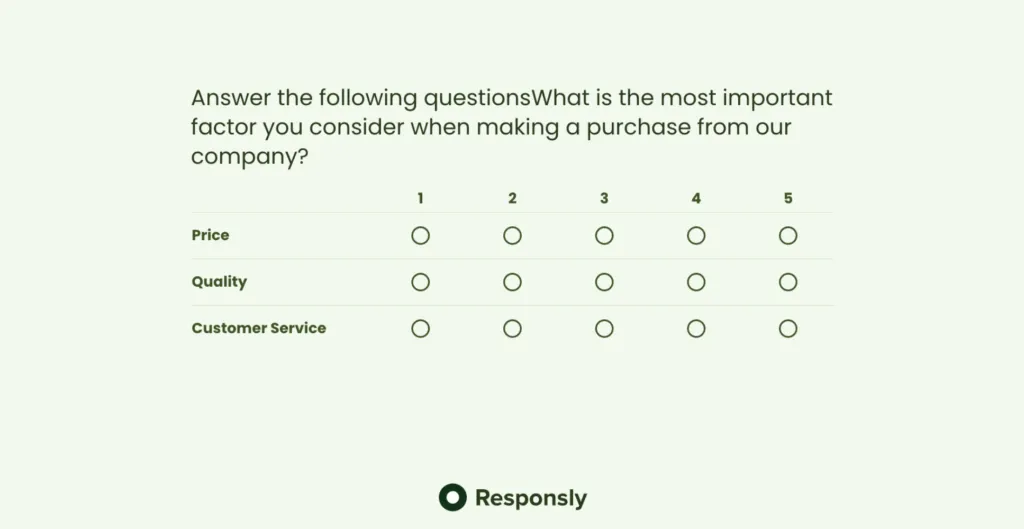
Pair closed questions (for scale and comparison) with one or two open-ended “why” questions (for context). Open text is where the real insight hides—and where AI analysis pays off, as we cover below.
Market research survey for a new product
For a new product, run a concept test: describe the product or show a mockup, then measure appeal, purchase intent, and price sensitivity. Keep it under 5 minutes, recruit a representative sample of your target audience, and always include a “What would make you more likely to buy this?” open question. The goal is a go/no-go signal and a prioritized list of changes before you invest in the build.
Market research survey for a new business
Before launching a business, use a market survey to validate demand and de-risk the idea: confirm the problem is real and painful, size the willingness to pay, map the competitive alternatives, and identify your strongest initial segment. A short, well-targeted survey here can save months of building something nobody wants.
How to conduct a market research survey: 6 steps
- Define the decision. Write down the exact business decision the survey must inform (launch, price, position, improve). If you can’t name the decision, you’re not ready to write questions.
- Pick the survey type and audience. Use the table above to match the type to the decision, then define who must answer and how many. A sample size calculator gives you the number of completed responses for your confidence level and margin of error.
- Write clear, unbiased questions. Mix closed questions for scale with one or two open-ended “why” questions. Avoid leading and double-barreled wording—our survey design guide covers this in depth.
- Distribute to a representative sample. Reach people where they are—email, link, SMS, panel, or website widget—so your sample reflects the market, not just your fans.
- Analyze quantitatively and qualitatively. Compare the numbers across segments, and theme the open text. AI analysis makes the qualitative side fast and consistent.
- Act and repeat. Turn findings into a decision, document it, and re-run the study periodically to track change over time.
Advantages and limitations of market research surveys
Surveys are powerful, but they’re not the only tool. Knowing the trade-offs keeps your conclusions honest.
Advantages
- Scalable and fast — reach hundreds or thousands of people in days, not weeks.
- Cost-effective — far cheaper than focus groups or agency studies, especially in-house.
- Comparable data — structured answers segment and benchmark easily.
- Flexible — combine quantitative scale with qualitative depth in one study.
Limitations
- Self-report bias — people don’t always do what they say; pair stated intent with behavioral data where you can.
- Sampling risk — a non-representative sample produces confident but wrong conclusions.
- Surface-level “why” — surveys reveal patterns; deeper motivations may still need interviews. Open-ended questions, analyzed with AI, narrow this gap considerably.
Market research survey templates
You don’t have to start from scratch. These ready-to-use templates cover the most common market research jobs:
- Market research survey template — a general-purpose starting point.
- Product research survey — preferences, usage habits, satisfaction, packaging, and pricing.
- Focus group survey — demographics, opinions, and suggestions for a small, in-depth group.
- Website survey — usability, visitor profile, and satisfaction for online experiences.
- Competitor research survey — strengths, weaknesses, and switching reasons.
- Brand perception survey — how customers rate your brand on quality, trust, and experience versus rivals.
Browse the full survey templates library for more.
How to run market research surveys with Responsly
Responsly is an AI-powered survey and feedback platform built to run market research in-house, end to end:
- Draft in seconds with the AI survey generator—describe your study and get a structured questionnaire to refine.
- Reach the right audience across email, link, SMS, and website widgets, so your sample is representative, not just convenient.
- Analyze open text automatically with Athena, Responsly’s AI agent, which clusters answers into themes and scores sentiment—turning hundreds of “why” responses into clear insight in minutes via feedback analytics.
- Track over time with NPS, CSAT, and CES so market research becomes continuous, not a one-off snapshot.
This is what makes DIY market research finally practical: the parts that used to need an agency—question design, distribution, and qualitative analysis—are now assisted by AI. Teams at Red Bull, DB Schenker, and Schneider Electric use Responsly to collect and act on this kind of data.
Conclusion
A market research survey is the most cost-effective way to replace guesswork with evidence—about your market, your customers, and your competitors. Choose the survey type that matches your decision, use proven questions and sound sampling, and analyze the open-ended answers as seriously as the numbers. Run it in-house, run it often, and let AI handle the heavy lifting.
Ready to start? Create a free Responsly account or open a market research survey template and launch your first study today.
FAQ
What is a market research survey?
What type of market research is a survey?
What are the main types of market research surveys?
What are common market survey techniques?
How do I run a market research survey for a new product?
What is the difference between a market research survey and a consumer research survey?
How many respondents do I need for a market research survey?
Tagged in
Last updated