Table of contents
A multiple choice question (MCQ) is a closed question that gives the respondent a stem and a fixed list of answer options, and asks them to pick one option or, in the multi-select form, several. This guide is for teachers and trainers who write graded quizzes, HR and L&D teams running knowledge checks, and researchers or CX teams who put multiple choice questions into surveys. It covers four things: which formats are genuinely multiple choice and which are rating scales that borrow the label, realistic MCQ examples with answer keys in three contexts, the item-writing rules that separate a fair question from one that gives itself away, and the cases where multiple choice is the wrong format altogether.
What is an MCQ (multiple choice question)?
An MCQ is a question with a fixed set of answers to choose from. In a test or quiz, one option (or a defined set) is correct and the rest are deliberate wrong answers called distractors. In a survey there is no correct answer: every option is a legitimate response, and the point is to count how people choose.
That double life is the source of most confusion about multiple choice questions. On screen, a quiz item and a survey item look identical. What differs is what the options are for: in a quiz, wrong options are engineered to tempt someone who has not mastered the material; in a survey, an option that tempts people towards an answer is a bias to remove.
MCQ is the abbreviation and MCQs the plural; “MCQ questions” says “question” twice but means the same thing.
The parts of a multiple choice question
- Stem – the question or problem. A good stem can be answered before reading the options.
- Options – the full list of answers, usually labelled A, B, C, D.
- Key – the correct or best option; in a multi-select item, a set of options.
- Distractors – the incorrect options: plausible to a novice, clearly wrong to an expert.
- Instruction – “Select one” or “Select all that apply”. The marker shape already signals it, but writing it out removes doubt.
- “Other” or “None of these” – a survey needs this to catch answers the list did not anticipate. A quiz usually does not.
Multiple choice questions with answers
Below are six example multiple choice questions in three settings, each set followed by its answer key. The first two sets have correct answers; the third, a customer survey, deliberately does not, and the notes explain why it needs different rules.
Knowledge quiz: MCQs with an answer key
1. In which year did the Berlin Wall fall?
- A. 1987
- B. 1989
- C. 1990
- D. 1991
2. Which of these numbers are prime? Select all that apply.
- A. 2
- B. 9
- C. 7
- D. 15
| Question | Key | Why the distractors work |
|---|---|---|
| 1. Fall of the Berlin Wall | B. 1989 | Each distractor is a real, adjacent event: Reagan’s “tear down this wall” speech (1987), German reunification (1990), the end of the Soviet Union (1991). Options run in date order, so position gives nothing away. |
| 2. Prime numbers | A. 2 and C. 7 | 9 and 15 catch anyone who equates “odd” with “prime”; 2 catches the opposite belief, that primes are always odd. |
Question 2 needs a scoring rule before it goes live: all-or-nothing, or partial credit with a deduction for wrong picks. Partial credit without a deduction rewards ticking every box.
Employee training check: MCQs with an answer key
3. You receive an email signed “IT Support” asking you to confirm your password through a link. What should you do first?
- A. Open the link to check whether the page looks genuine
- B. Reply to the sender and ask whether the request is real
- C. Report it through the phishing reporting process, unopened
- D. Forward it to your team so they know to ignore it
4. Under the GDPR, how long does an organisation normally have to answer a data subject access request?
- A. 72 hours
- B. 14 days
- C. One month
- D. Six months
| Question | Key | Why the distractors work |
|---|---|---|
| 3. Suspicious “IT Support” email | C | A is the exact behaviour the training is meant to stop; B and D feel responsible, which makes them plausible. All four options are the same length, so the key does not stand out. |
| 4. Deadline for an access request | C. One month | 72 hours is the GDPR deadline for reporting a personal data breach, a genuine and common confusion. “Three months” is left out on purpose: with the extension allowed for complex requests it can be correct, and an item with two defensible answers is broken, not hard. |
In your own training checks the key comes from your policy, not from general knowledge. That is what makes a wrong answer useful: it points to the paragraph someone has not absorbed.
Customer survey: multiple choice questions with no correct answer
5. How did you first hear about us?
- A. Search engine
- B. Recommendation from someone I know
- C. Social media
- D. Online advertisement
- E. Other (please specify)
6. Which of these features have you used in the last 30 days? Select all that apply.
- A. Scheduled reports
- B. Shared dashboards
- C. Mobile app
- D. None of these
There is no answer key here, and that is the point. Every option is a legitimate response; what you analyse is the distribution. In place of a key, a survey MCQ needs an analysis plan.
| Question | What replaces the answer key | Design rule it illustrates |
|---|---|---|
| 5. First heard about us | Share of respondents per channel, compared with your attribution data | Options are mutually exclusive and, with “Other”, exhaustive |
| 6. Features used | Share of respondents who ticked each feature, summing above 100% | “None of these” makes a blank answer unambiguous |
Quiz and survey multiple choice questions follow opposite rules:
- Tempting options. A quiz distractor is designed to be wrong and attractive. In a survey, every option should be equally easy to pick.
- Option order. A quiz shuffles options so position cannot hint at the key. A survey shuffles unordered lists like question 5, but never a scale.
- “None of the above”. Weak in a quiz, often required in a survey, where the real answer may not be on your list.
- The result. A quiz produces a score per person; a survey produces a percentage per option, read across segments.
What are the types of multiple choice questions?
Strictly, five formats are true choice questions: single select, multi-select, dropdown, yes/no (including true/false) and picture choice. Star and smiley ratings, sliders, matrix tables and rank order are also closed-ended and often listed as multiple choice types, but they ask for a position on a scale or an order, so they are analysed differently.
The distinction matters in the results. A choice question produces counts per option; a rating scale produces a score you can average. Averaging “How did you hear about us?” is meaningless, and treating five stars as five unrelated categories discards their order. The wider family of closed formats, Likert scales included, is covered in our guide to closed-ended questions, and every format, open questions included, in survey question types.
| Type | Respondent | True choice question? | Data you get | Typical use |
|---|---|---|---|---|
| Single select | Picks one option | Yes | Share per option | Quiz items, demographics |
| Multi-select | Ticks all that apply | Yes | Share per option, summing above 100% | Features used, channels |
| Dropdown | Picks one from a collapsed list | Yes | Share per option | Country, department |
| Yes/no, true/false | Picks one of two | Yes | Two-way split | Screening, quick checks |
| Picture choice | Picks an image | Yes | Share per image | Logos, packaging |
| Star or smiley rating | Marks a point on a scale | No, a rating scale | Average and distribution | Satisfaction with one thing |
| Slider | Drags a handle along a range | No, a rating scale | A number in the range | Fine-grained intensity |
| Matrix table | Rates several rows on one scale | Each row is a rating | Score per row | Several attributes at once |
| Rank order | Puts items in order | No, a ranking | Position per item | Priorities, trade-offs |
Single select multiple choice question
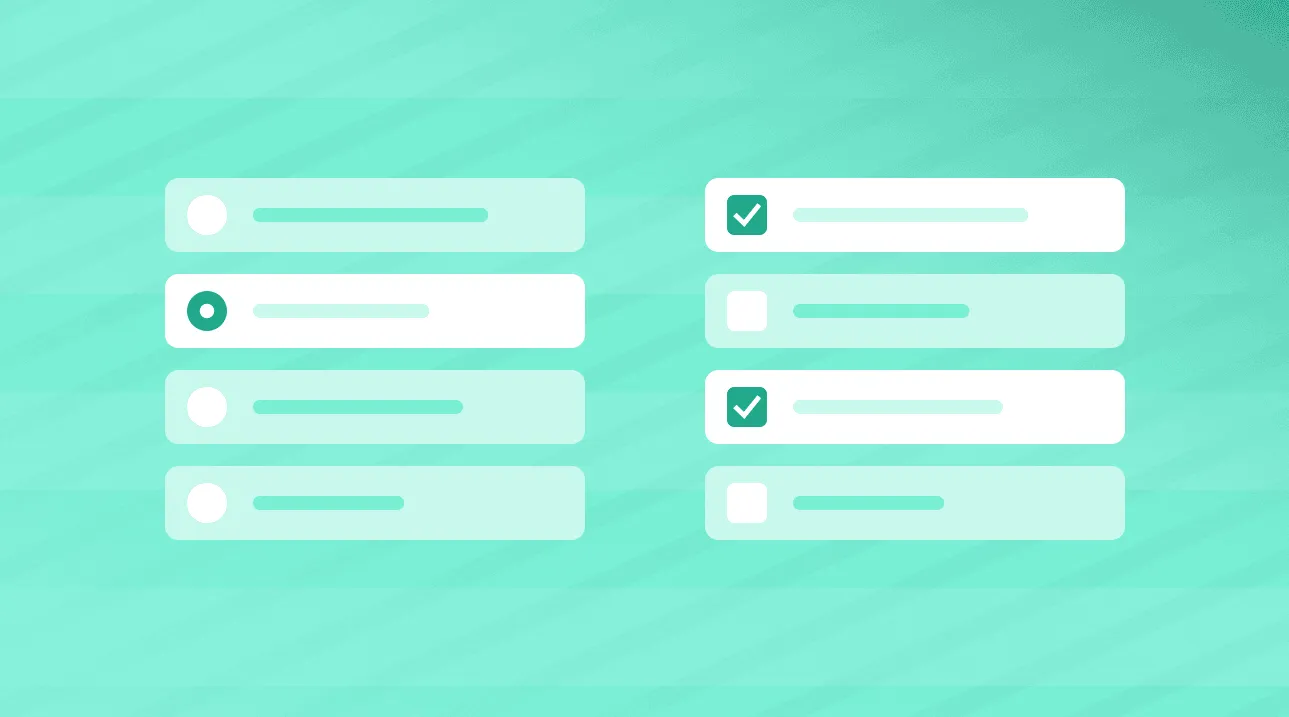
One answer from a list, shown with round radio buttons. It is the default MCQ and the right format whenever answers are mutually exclusive: one capital city, one main reason, one age band. It is also the easiest format to answer on a phone.

Multi-select multiple choice question
Square checkboxes, any number of answers, for questions where several answers can be true at once. Say “Select all that apply” in the stem and add “None of these”, because an unticked box can mean “no” or “did not read this far”.
Dropdown multiple choice question
A single select question with the list collapsed. It saves space for long, familiar lists such as country or department, where people know their answer before they look. For short lists it is worse than radio buttons: it hides the options and adds a tap.
Yes/no and thumbs up/down questions
A dichotomous question: two options, one choice, with or without icons. Fast to answer and easy to analyse, but it forces a binary onto opinions that often are not binary. In a quiz, a true/false item carries a 50% chance of a correct blind guess.

Picture choice (image-based multiple choice)
Single or multiple select where the options are images: a logo, a pack shot, a photo of a hazard in safety training. Give every image a short text label, so the results are readable and the question works with screen readers.
Star and smiley rating questions
Here the scope changes. A five-star or smiley rating asks for a position on one scale, not a choice between different answers. It looks like a row of options, which is why it lands in lists of multiple choice types, but its result is a score: report the average and the distribution, and track them over time.
Slider and numeric slider questions
A rating scale with a handle instead of fixed points, often 0–10 or 0–100, for answers that sit between neat categories: “How confident are you using the new reporting module?” from 0 to 100. Like any rating scale, it gives you a number to average, not a choice to count.
Matrix table multiple choice question
Several rows that share one answer scale. It saves space and makes rows easy to compare, but long grids invite straight-lining, where respondents tick the same column all the way down.
Rank order multiple choice question
Ranking asks people to order items rather than choose among them. It forces trade-offs that ratings let people avoid, and it gets harder with every item; on long lists the middle positions are the least considered. Analyse it as each item’s average position, or the share who placed it first.
How do you write good multiple choice questions?
Write a stem that poses one complete problem, so someone who knows the material could answer before seeing the options. Give exactly one defensible key. Build distractors from real misconceptions, keep all options similar in length and grammar, and remove anything that lets a test-wise guesser find the key without knowing the subject.
University teaching centres agree on most rules for writing multiple choice questions. A compact, well-referenced version is the University of Waterloo Centre for Teaching Excellence guide to designing multiple-choice questions; the checklist below follows it.
The stem
- One problem per stem. Cover the options: if an expert cannot answer, the stem is incomplete.
- Shared words go in the stem, not repeated in every option.
- Cut background nobody needs to answer. Reading load is not difficulty.
- Prefer a direct question to an unfinished sentence. It removes most grammatical cues.
The key
- Exactly one best answer, or a defined set for multi-select. Ask a colleague who knows the subject to answer without the key; if they argue convincingly for a second option, the item is broken.
- Spread the key across positions, or let the tool shuffle options, so “C” is not the safe guess.
The distractors
- Plausible. Base them on real mistakes. Wrong answers from an earlier open-ended version of the question are the best source.
- Homogeneous. Same length, grammatical form and level of detail as the key.
- Mutually exclusive, so no two can be eliminated together.
- As many as you can make plausible. Michael Rodriguez’s 2005 meta-analysis of 80 years of research (Educational Measurement: Issues and Practice) concluded that three options are optimal for most items, because an option nobody picks adds reading time, not difficulty. Guides differ: the University of Illinois Center for Innovation in Teaching & Learning recommends at least four. Quality beats count.
Common flaws that give the answer away
| Flaw | Example | Why it hurts | Fix |
|---|---|---|---|
| ”All of the above” | D is “All of the above” | Recognising two correct options is enough to pick D | Make it a multi-select item |
| ”None of the above” as the key | The correct answer is not listed | A right pick only shows the listed options were rejected | Write the correct answer in |
| Negative stem | ”Which of these is NOT a GDPR principle?” | It tests attention, not knowledge | Ask positively, or put NOT in bold capitals |
| Length cue | Only the key has a qualifying clause | Test-wise people pick the longest option | Match length and detail |
| Grammatical cue | Stem ends in “an”; one option starts with a vowel | The article points at the key | Use a direct question |
| Absolute words | ”Always” and “never” only in distractors | Absolutes flag an option as wrong | Remove them, or use them in the key too |
Survey MCQs need three further checks: options that are exhaustive (add “Other” when unsure), mutually exclusive (no overlapping ranges such as 18–25 and 25–34) and, on anything evaluative, balanced between positive and negative.
If an AI tool drafted your questions, run the same checks on its output. Our guide to the AI MCQ quiz generator covers generating and reviewing multiple choice questions with AI.
When is multiple choice the wrong format?
When you need people to produce something rather than recognise it, when you do not yet know the realistic range of answers, or when one score has to carry a high-stakes decision on its own. Multiple choice measures recognition among the options you wrote, so it can only ever be as good as that list.
- Production skills. Writing, explaining a decision, handling a difficult customer: an MCQ checks whether someone recognises the right approach, not whether they can carry it out. Use an open question or a work sample.
- Guessing. With four options a blind guess is right 25% of the time, so a ten-item quiz has an expected score of 2.5 from guessing alone. One item is weak evidence; many items are stronger.
- An unknown answer space. Survey options written before you know how people think about a topic measure your assumptions. Ask it open-ended with a small group first, then build the options from what they said; our guide to open-ended questions covers when to keep it open.
- Weak items. Weak distractors produce inflated scores that look like learning.
- High-stakes testing. Certification or hiring needs question pools, time limits and a record of who saw which version. Invigilation, browser lockdown or identity checks call for a dedicated exam platform.
| Multiple choice | Open-ended | |
|---|---|---|
| What it measures | Recognition among your options | Recall, reasoning, the respondent’s own words |
| Analysis | Automatic counts, percentages, scores | Reading and coding, or AI theme analysis |
| Respondent effort | Low | High |
| Main risk | Your list frames the answers | Fewer, shorter answers |
| Best for | Knowledge checks at scale, tracking over time | Discovery, “why” follow-ups |
Creating multiple choice questions in Responsly
Responsly is an AI-powered customer feedback and survey platform, and the same choice question type sits behind its quizzes, surveys and forms:
- Choice questions with the settings above. Single choice, multiple answers with an optional minimum and maximum, an “Other” option with its own text field, and random answer order per respondent. The help article on choice question settings shows where each lives.
- Quizzes with an answer key. In the quiz maker you mark the correct answer with Compare Answer and reveal it after the question or at the end, assign points per answer with the Calculator, and show the total on the end page, with different endings for high and low scores.
- Fairer test conditions. Draw a random subset of questions from a pool for each person, shuffle questions and answers, and set a time limit for the whole quiz or a single question. Plan around one limitation: random question order and skip logic do not work together in the same survey.
- AI drafting. Describe the topic, number of questions and difficulty, and the AI quiz generator drafts questions with correct answers marked and scoring set up; an existing question bank can be pasted in and turned into an editable quiz. It runs on the same engine as the AI survey generator. Review the distractors before publishing.
- Survey MCQs and analysis. In the survey maker, charts and cross-tabs update as answers come in. Athena, Responsly’s AI agent, groups open-ended answers, including text typed into “Other”, into themes with sentiment.
Where it is not the right tool: Responsly is not an invigilated exam platform, so a test that requires proctoring, browser lockdown or identity verification belongs in a dedicated exam tool.
Summary
Multiple choice questions do two jobs. In a quiz they have a key and distractors built to be wrong in instructive ways; in a survey there is no key, and every option must be a fair, possible answer. Only five formats are true choice questions. Most of the quality comes from the items: a complete stem, one defensible key, distractors drawn from real mistakes, and a pilot.
Create a free account and build your first multiple choice quiz or survey.