All posts
Karolina Konopka
Customer Success Manager

 7 min read
Listen and understand your customers. Win them at any stage of their journey.
cx Platform

In the digital age, where information flows freely across the vast internet landscape, understanding how people feel about a particular topic or brand is invaluable. Whether it’s for businesses aiming to gauge customer satisfaction or researchers analyzing public opinion, sentiment analysis has become a cornerstone in extracting meaningful insights from the sea of online data. And at the heart of sentiment analysis lies a crucial metric: the Net Sentiment Score.
What is the Net Sentiment Score?
In its essence, the Net Sentiment Score (NSS) is a metric used to quantify the overall sentiment expressed towards a particular entity, such as a product, service, or topic, based on the sentiment of individual mentions or interactions. It provides a succinct representation of whether the sentiment is positive, negative, or neutral, and to what extent.
The Net Sentiment Score meaning can be understood as a single number that captures the “net” feeling—the balance between positive and negative sentiments—across all analyzed text data. Also known as NSS score or simply net sentiment, this metric transforms complex textual feedback into actionable insights.
Unlike simple star ratings, NSS is derived from unstructured text data—comments, reviews, emails, and chat logs. This makes it a powerful tool for understanding the why behind the score.
How to Calculate the Net Sentiment Score
The Net Sentiment Score calculation is straightforward once you understand the process. Here’s a step-by-step guide on how to calculate Net Sentiment Score:
Step 1: Collect and Classify Sentiment Data
First, gather all text data you want to analyze (reviews, comments, survey responses, etc.) and classify each mention as:
- Positive: Expresses favorable sentiment
- Negative: Expresses unfavorable sentiment
- Neutral: No clear positive or negative sentiment
This classification can be done manually or automatically using Natural Language Processing (NLP) tools.
Step 2: Calculate Percentages
Count the total number of mentions and calculate what percentage are positive and what percentage are negative. Neutral mentions are typically excluded from the calculation.
Step 3: Apply the NSS Formula
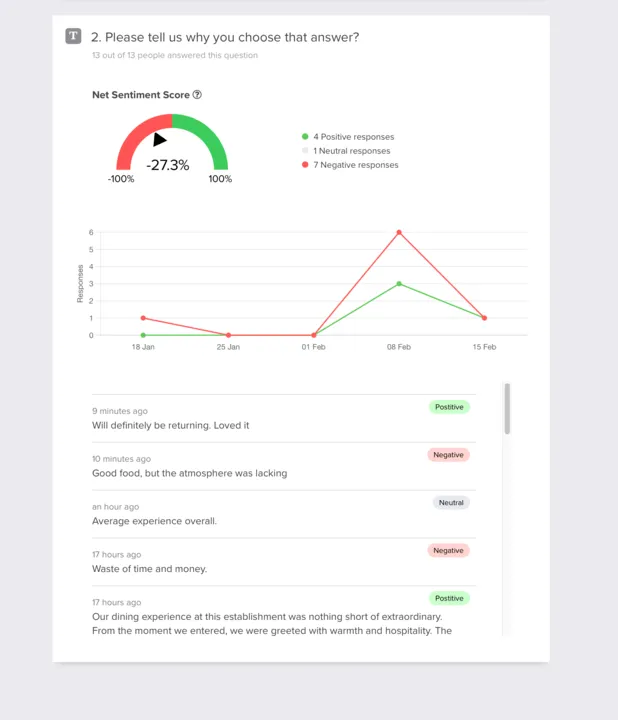
Once the sentiment of individual mentions is determined, the Net Sentiment Score is calculated by aggregating these sentiments and deriving an overall score. This score concisely summarizes the prevailing sentiment surrounding the entity of interest, making it easier to interpret and track sentiment trends over time.
Taking a page from the popular Net Promoter Score, which is well known and simple to understand, we will boil down all the sentiment data to a single number: the Net Sentiment Score (NSS).
The NSS Formula
The Net Sentiment Score formula (also called NSS formula) is simply the percentage of positive sentiments minus the percentage of negative sentiments.Step 4: Interpret the Result
- Positive NSS: More positive than negative sentiment (score > 0)
- Negative NSS: More negative than positive sentiment (score < 0)
- Zero NSS: Balanced sentiment (equal positive and negative)
Example Calculation
For example, if you analyze 1,000 comments and find:
600 are Positive (60%)
200 are Negative (20%)
200 are Neutral (20%)
This means you have a positive net sentiment of 40, indicating that positive feedback significantly outweighs negative feedback.
Note: The Net Sentiment Score is sometimes referred to as net sentiment rate in certain contexts, though both terms refer to the same calculation method.
Net Sentiment Score vs Net Promoter Score
When it comes to measuring customer sentiment and satisfaction, two metrics often come into play: NSS (Net Sentiment Score) and NPS (Net Promoter Score). While they sound similar, they measure different things.
| Feature | Net Sentiment Score (NSS) | Net Promoter Score (NPS) |
|---|---|---|
| Data Source | Unstructured text (reviews, comments, social media) | Structured survey question (0-10 scale) |
| Question Asked | None (Passive analysis of existing text) | “How likely are you to recommend us?” |
| Best For | Understanding specific topics, emotions, and “why” | Measuring overall brand loyalty and growth potential |
| Calculation | % Positive - % Negative | % Promoters - % Detractors |
While NPS tells you how loyal your customers are, NSS tells you what they are feeling right now about specific topics. Combining both gives you a complete picture of your customer experience.
Why is the Net Sentiment Score Important?
The importance of the NSS lies in its ability to distill vast amounts of textual data into actionable insights. Here’s why it’s a valuable metric in various domains:
Business Insights: Understanding customer sentiment is crucial for businesses to maintain brand reputation, improve products or services, and guide marketing strategies. By tracking the Net Sentiment Score over time, companies can gauge the effectiveness of their efforts in addressing customer concerns and fostering positive sentiment.
Market Research: In market research, the NSS serves as a powerful tool for understanding consumer experience, identifying emerging trends, and benchmarking against competitors. Researchers can uncover valuable insights into consumer behavior and sentiment dynamics by analyzing sentiment across different demographic segments or geographical regions.
Brand Monitoring: Monitoring online sentiment is essential for brand management and crisis mitigation. A sudden dip in the Net Sentiment Score could signal a potential PR crisis or negative publicity, prompting immediate action to address underlying issues and mitigate reputational damage.
Political Analysis: In the realm of politics, the NSS offers valuable insights into public opinion, candidate perception, and electoral dynamics. Political analysts can gauge voter sentiment, predict election outcomes, and tailor campaign strategies by analyzing sentiment across social media platforms and news articles.
Product Development: For product developers, the NSS provides valuable feedback on product features, usability, and overall customer satisfaction. By analyzing sentiment expressed in product reviews and user feedback, developers can identify areas for improvement and prioritize features that resonate positively with users.
Global Reach: With the possibility of collecting data in many languages and the ability to translate it for analysis, the NSS becomes even more valuable for organizations operating on a global scale. This allows businesses to gain insights into customer sentiment across diverse linguistic and cultural contexts, enabling more informed decision-making and targeted strategies for different markets.
Sentiment Score vs. Net Sentiment Score
It is important to distinguish between a simple Sentiment Score and the Net Sentiment Score (also called sentiment net):
Sentiment Score: Usually assigns a value to a single piece of text (e.g., +1 for positive, -1 for negative).
Net Sentiment Score: Aggregates these values across a dataset to provide a high-level trend. It subtracts the negatives from the positives to show the “net” feeling.
A positive NSS indicates a predominance of positive sentiments, while a negative score indicates that negative feedback outweighs the positive.
Challenges and considerations
While the NSS is a powerful tool for sentiment analysis, it’s not without its challenges and limitations. Some considerations include:
Contextual Understanding: Sentiment analysis algorithms may struggle with understanding context, sarcasm, or nuanced language, leading to inaccuracies in sentiment classification.
Bias and Noise: Text data often contains noise and bias, which can affect the accuracy of sentiment analysis. Preprocessing techniques and careful model selection are essential for mitigating these issues.
Language and Cultural Variations: Sentiment analysis models trained on one language or cultural context may not generalize well to others, necessitating adaptation or multilingual approaches.
Dynamic Nature of Sentiment: Sentiment is inherently dynamic and subject to change over time, making it essential to track sentiment trends continuously and adapt analysis strategies accordingly.
In conclusion, the Net Sentiment Score is a powerful metric for understanding and quantifying sentiment in textual data. Whether it’s for businesses seeking to enhance customer satisfaction, researchers analyzing public opinion, or political analysts gauging voter sentiment, the NSS provides a valuable tool for extracting actionable insights from the vast landscape of online discourse. While challenges exist, advancements in natural language processing and sentiment analysis techniques continue to improve the accuracy and applicability of the NSS, making it an indispensable asset in the realm of data science and analytics.
Ready to start measuring sentiment? Use Responsly’s survey templates to collect feedback and start tracking your sentiment trends today.