Table of contents
In the digital age, where information flows freely across the vast internet landscape, understanding how people feel about a particular topic or brand is invaluable. Whether it’s for businesses aiming to gauge customer satisfaction or researchers analyzing public opinion, sentiment analysis has become a cornerstone in extracting meaningful insights from the sea of online data. And at the heart of sentiment analysis lies a crucial metric: the Net Sentiment Score. NSS is one member of the broader sentiment score family, and this guide covers both: how a sentiment score is produced for a single piece of text, and how the net version aggregates those scores into one trackable number.
What is the Net Sentiment Score?
In its essence, the Net Sentiment Score (NSS) is a metric used to quantify the overall sentiment expressed towards a particular entity, such as a product, service, or topic, based on the sentiment of individual mentions or interactions. It provides a succinct representation of whether the sentiment is positive, negative, or neutral, and to what extent.
The Net Sentiment Score meaning can be understood as a single number that captures the “net” feeling—the balance between positive and negative sentiments—across all analyzed text data. Also known as NSS score or simply net sentiment, this metric transforms complex textual feedback into actionable insights.
Unlike simple star ratings, NSS is derived from unstructured text data—comments, reviews, emails, and chat logs. This makes it a powerful tool for understanding the why behind the score.
How to Calculate the Net Sentiment Score
The Net Sentiment Score calculation is straightforward once you understand the process. Here’s a step-by-step guide on how to calculate Net Sentiment Score:
Step 1: Collect and Classify Sentiment Data
First, gather all text data you want to analyze (reviews, comments, survey responses, etc.) and classify each mention as:
- Positive: Expresses favorable sentiment
- Negative: Expresses unfavorable sentiment
- Neutral: No clear positive or negative sentiment
This classification can be done manually or automatically using Natural Language Processing (NLP) tools.
Step 2: Calculate Percentages
Count the total number of mentions and calculate what percentage are positive and what percentage are negative. Neutral mentions are typically excluded from the calculation.
Step 3: Apply the NSS Formula
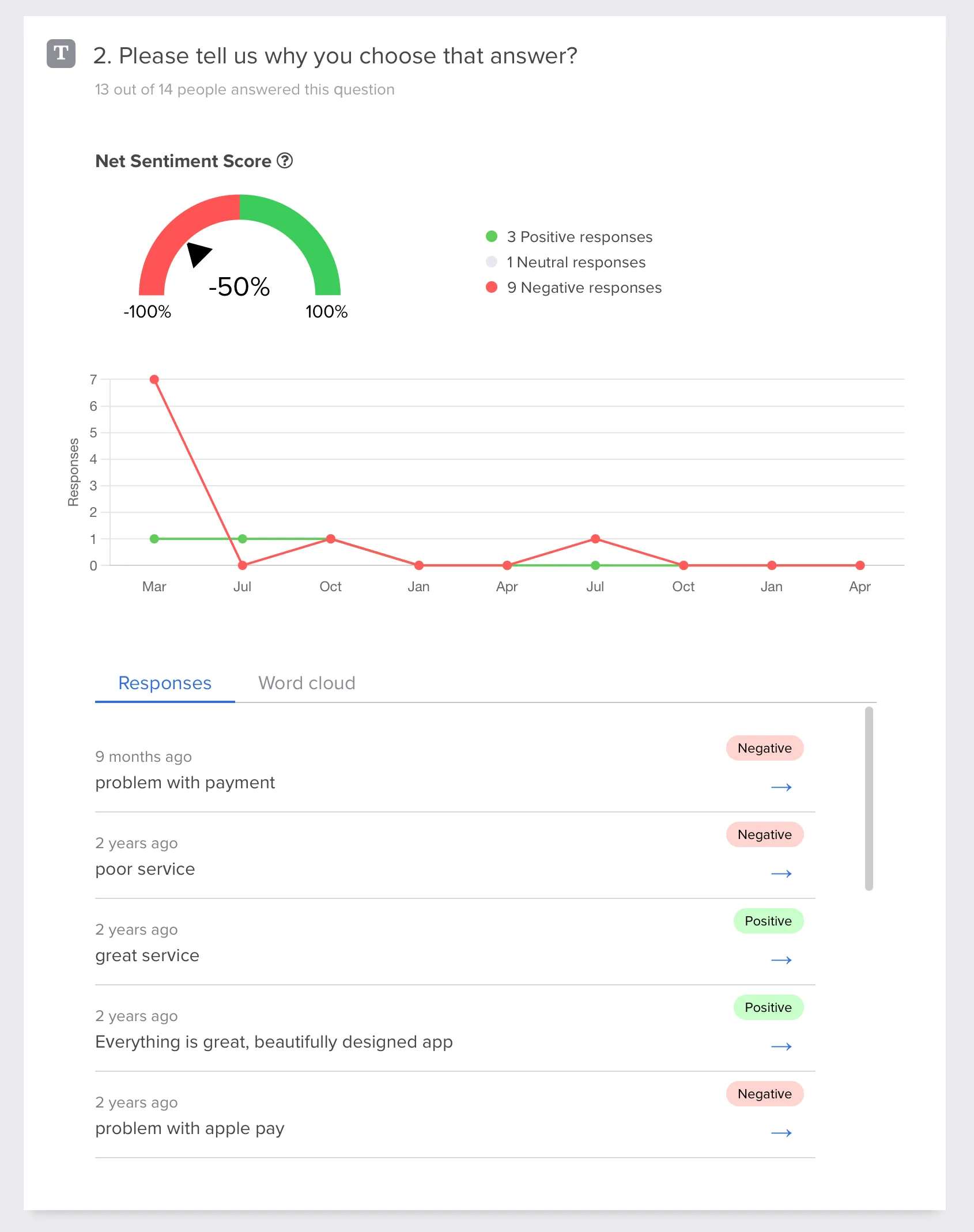
Once the sentiment of individual mentions is determined, the Net Sentiment Score is calculated by aggregating these sentiments and deriving an overall score. This score concisely summarizes the prevailing sentiment surrounding the entity of interest, making it easier to interpret and track sentiment trends over time.
Taking a page from the popular Net Promoter Score, which is well known and simple to understand, we will boil down all the sentiment data to a single number: the Net Sentiment Score (NSS).
The NSS Formula
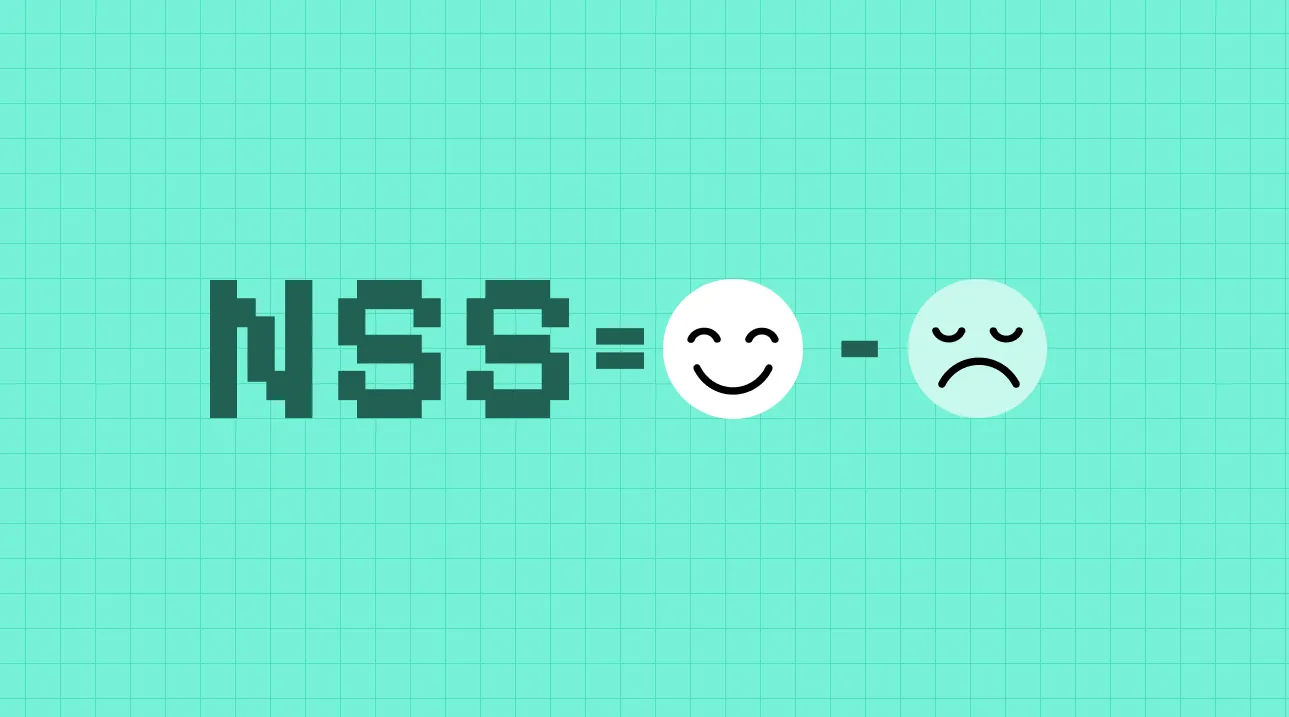
The Net Sentiment Score formula (also called NSS formula) is simply the percentage of positive sentiments minus the percentage of negative sentiments.Step 4: Interpret the Result
- Positive NSS: More positive than negative sentiment (score > 0)
- Negative NSS: More negative than positive sentiment (score < 0)
- Zero NSS: Balanced sentiment (equal positive and negative)
Example Calculation
For example, if you analyze 1,000 comments and find:
600 are Positive (60%)
200 are Negative (20%)
200 are Neutral (20%)
This means you have a positive net sentiment of 40, indicating that positive feedback significantly outweighs negative feedback.
Note: The Net Sentiment Score is sometimes referred to as net sentiment rate in certain contexts, though both terms refer to the same calculation method.
Rather not do the arithmetic by hand? Our free Net Sentiment Score calculator lets you click through example customer comments, shows how each one is classified, and builds the score up in front of you.
What is a good Net Sentiment Score?
There is no universal benchmark, because NSS depends on what you analyse and how strictly your classifier treats neutral text. As a working guide:
- Above 0 — more positive than negative mentions. The floor, not the goal.
- 0 to 20 — mixed. Positive sentiment exists but a meaningful share of your audience is unhappy.
- 20 to 50 — good. Positive mentions clearly outweigh negative ones.
- Above 50 — excellent, and worth checking for sampling bias before celebrating.
- Below 0 — negative feedback dominates. Treat it as a reputation problem, not a metric problem.
You can try these bands against a sample of your own in the Net Sentiment Score calculator.
Two caveats matter more than the bands themselves. First, the score moves when your neutral threshold moves: a classifier that files lukewarm comments as neutral produces a higher NSS than one that files them as negative, without anything changing in customer opinion. Second, NSS is not comparable across sources — reviews skew polarised, support tickets skew negative, and post-purchase surveys skew positive. Compare a source against its own history, not against another source or a published average.
Net Sentiment Score vs Net Promoter Score
When it comes to measuring customer sentiment and satisfaction, two metrics often come into play: NSS (Net Sentiment Score) and NPS (Net Promoter Score). While they sound similar, they measure different things.
| Feature | Net Sentiment Score (NSS) | Net Promoter Score (NPS) |
|---|---|---|
| Data Source | Unstructured text (reviews, comments, social media) | Structured survey question (0-10 scale) |
| Question Asked | None (Passive analysis of existing text) | “How likely are you to recommend us?” |
| Best For | Understanding specific topics, emotions, and “why” | Measuring overall brand loyalty and growth potential |
| Calculation | % Positive - % Negative | % Promoters - % Detractors |
While NPS tells you how loyal your customers are, NSS tells you what they are feeling right now about specific topics. Combining both gives you a complete picture of your customer experience.
Why is the Net Sentiment Score Important?
The importance of the NSS lies in its ability to distill vast amounts of textual data into actionable insights. Here’s why it’s a valuable metric in various domains:
Business Insights: Understanding customer sentiment is crucial for businesses to maintain brand reputation, improve products or services, and guide marketing strategies. By tracking the Net Sentiment Score over time, companies can gauge the effectiveness of their efforts in addressing customer concerns and fostering positive sentiment.
Market Research: In market research, the NSS serves as a powerful tool for understanding consumer experience, identifying emerging trends, and benchmarking against competitors. Research teams can uncover valuable insights into consumer behavior and sentiment dynamics by analyzing sentiment across different demographic segments or geographical regions.
Brand Monitoring: Monitoring online sentiment is essential for brand management and crisis mitigation. A sudden dip in the Net Sentiment Score could signal a potential PR crisis or negative publicity, prompting immediate action to address underlying issues and mitigate reputational damage.
Political Analysis: In the realm of politics, the NSS offers valuable insights into public opinion, candidate perception, and electoral dynamics. Political analysts can gauge voter sentiment, predict election outcomes, and tailor campaign strategies by analyzing sentiment across social media platforms and news articles.
Product Development: For product developers, the NSS provides valuable feedback on product features, usability, and overall customer satisfaction. By analyzing sentiment expressed in product reviews and user feedback, developers can identify areas for improvement and prioritize features that resonate positively with users.
Global Reach: With the possibility of collecting data in many languages and the ability to translate it for analysis, the NSS becomes even more valuable for organizations operating on a global scale. This allows businesses to gain insights into customer sentiment across diverse linguistic and cultural contexts, enabling more informed decision-making and targeted strategies for different markets.
Sentiment score vs Net Sentiment Score
The two terms are used interchangeably far too often, and the difference decides which number you should be reporting.
| Sentiment score | Net Sentiment Score | |
|---|---|---|
| Unit of analysis | One piece of text | A whole set of texts |
| Typical output | −1 to +1, or a positive / neutral / negative label | A single net figure, usually −100 to +100 |
| Produced by | An NLP model reading the text | Aggregating the labels that model assigned |
| Answers | How does this comment feel? | Which way is the whole corpus leaning? |
In other words, the sentiment score is the input and the Net Sentiment Score is the output. You cannot have the second without the first.
How a sentiment score is calculated
Scoring a single piece of text is a natural language processing job, and there are four common approaches:
- Lexicon-based. Every word is looked up in a dictionary that carries a sentiment weight, and the weights are summed or averaged. Transparent and cheap, but blind to context — “not bad” scores as negative.
- Machine learning. A model is trained on text whose sentiment is already labelled, learns which patterns predict which label, and then scores new text. More accurate, and it needs training data.
- Rule-based. Hand-written patterns decide the outcome: certain words, negations, or phrasings map to a sentiment. Predictable and easy to audit, laborious to maintain.
- Hybrid. A lexicon or rule layer over a model, which is what most production systems actually use.
Whichever method you pick, the text usually gets cleaned first — punctuation and filler words removed, the text split into words or phrases — before any scoring happens.
Worked example
Take the sentence “The new smartphone is amazing! It’s fast, sleek, and has great features.” A lexicon-based method finds four sentiment-bearing words:
| Word | Weight |
|---|---|
| amazing | +0.9 |
| fast | +0.7 |
| sleek | +0.8 |
| great | +0.8 |
A score of 0.8 marks the comment as strongly positive. Run that over a thousand comments, count how many landed positive and how many negative, and you have the inputs for the NSS formula above.
What counts as a good sentiment score
For an individual text on a −1 to +1 scale, the reading is simpler than for NSS: close to +1 is clearly positive, close to −1 clearly negative, and around 0 means the model found nothing to go on. What “good” means still depends on context — above +0.5 in a customer feedback survey is genuinely positive feedback, while a film review sitting at −0.7 may be a well-argued negative review rather than a problem. Judge scores against others in the same dataset and against the same dataset over time; a single score in isolation says very little.
Challenges and considerations
While the NSS is a powerful tool for sentiment analysis, it’s not without its challenges and limitations. Some considerations include:
Contextual Understanding: Sentiment analysis algorithms may struggle with understanding context, sarcasm, or nuanced language, leading to inaccuracies in sentiment classification.
Bias and Noise: Text data often contains noise and bias, which can affect the accuracy of sentiment analysis. Preprocessing techniques and careful model selection are essential for mitigating these issues.
Language and Cultural Variations: Sentiment analysis models trained on one language or cultural context may not generalize well to others, necessitating adaptation or multilingual approaches.
Dynamic Nature of Sentiment: Sentiment is inherently dynamic and subject to change over time, making it essential to track sentiment trends continuously and adapt analysis strategies accordingly.
How to keep sentiment scoring accurate
Most of these limits can be managed. Use a lexicon broad enough to cover how your customers actually write, not just formal English. Layer a trained model over it so the system learns context instead of matching words. Retrain on your own labelled data as it accumulates, because a model tuned to your domain will beat a general-purpose one on your vocabulary. And re-check the classifier against a hand-labelled sample every so often — sentiment scoring drifts quietly, and a wrong neutral threshold moves your NSS without anyone noticing. Sentiment is one input among several; how it fits alongside themes, scores, and prioritisation is covered in our guide to customer feedback analysis.
In conclusion, the Net Sentiment Score is a powerful metric for understanding and quantifying sentiment in textual data. Whether it’s for businesses seeking to enhance customer satisfaction, researchers analyzing public opinion, or political analysts gauging voter sentiment, the NSS provides a valuable tool for extracting actionable insights from the vast landscape of online discourse. While challenges exist, advancements in natural language processing and sentiment analysis techniques continue to improve the accuracy and applicability of the NSS, making it an indispensable asset in the realm of data science and analytics.
With Responsly, you don’t have to calculate NSS by hand: Athena, our AI agent, automatically tags open-ended survey answers as positive, negative, or neutral and turns them into live feedback analytics — so your Net Sentiment Score updates in real time as responses arrive.
Ready to start measuring sentiment? Use Responsly’s survey templates or spin up a study in seconds with the AI survey generator to collect feedback and start tracking your sentiment trends today.
FAQ
What is a good Net Sentiment Score?
How to calculate Net Sentiment Score?
What is NSS score?
How is Net Sentiment Score different from CSAT?
Can I automate Net Sentiment Score calculation?
What is the difference between a sentiment score and a Net Sentiment Score?
How is a sentiment score calculated?
What is a good sentiment score?
What data sources can be used for NSS?
Tagged in
Last updated