
Movie Quiz
Engage your audience with a quiz about their favorite movie or TV series.
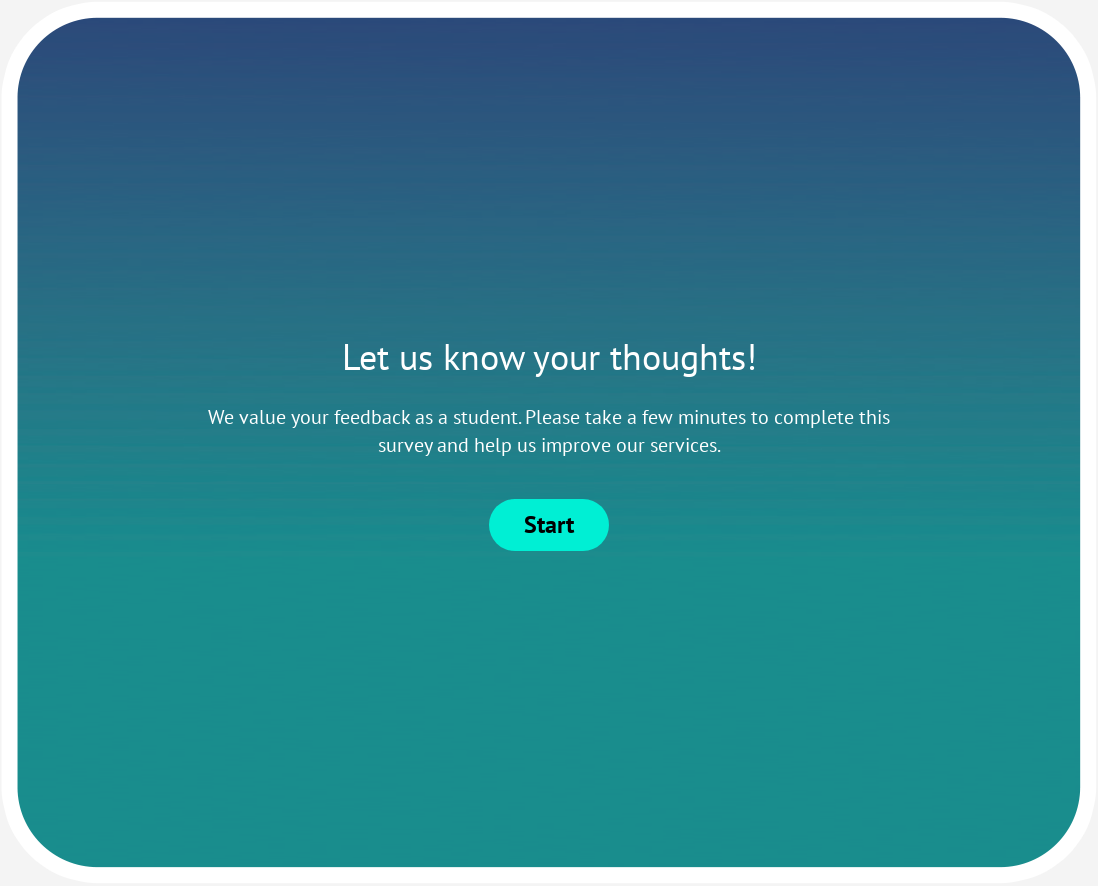
Grades show outcomes. Student feedback shows what is creating those outcomes while there is still time to improve. This Student Feedback Survey Template helps educators capture learning experience signals early enough to adjust teaching, materials, and support.
It is designed for schools, universities, bootcamps, and cohort-based programs that want practical course improvement cycles, not end-of-term data archives.
Measure factors that affect actual learning:
If you are only measuring “overall satisfaction,” you usually miss where learning quality is actually breaking down.
Different course moments need different question intent:
For blended delivery, keep one shared core block and use skip logic so online and in-person students see context-specific items.
Use simple scales and one concept per question. For example, keep “clarity of instruction” separate from “engagement in class” so teams can act on results without guessing.
Use one short open-ended prompt to capture what structured items miss, but avoid long essay-style forms that reduce completion.
Deploy through LMS links, class announcements, or post-session email. If your program serves multilingual cohorts, use multilingual surveys so wording does not become a hidden barrier to response quality.
For recurring programs, keep timing consistent across cohorts so trend comparisons are meaningful.
Use survey data analysis to compare courses, cohorts, and delivery formats, then publish a short “what we changed” update to students and instructors. Visible follow-through is what improves future response quality.
For deeper design practices, review survey design and qualitative vs quantitative research.
Use this template in Responsly to run mid-course and end-course feedback loops with consistent structure, cleaner segmentation, and action-ready outputs for your teaching team.
Here are examples of questions most commonly used in Student Feedback Survey Template. When using our template, you can edit and adjust all the questions.
You can modify every question, delete or add more; there are 24 types of questions with options to select.
Make it looks like it's your own. Add branding of your organization and modify the theme to match the graphic standards of your brand.
Easily connect Responsly to apps that you're using. Use ready integrations to move data from Responsly to your apps automatically.
Connect tools that you are using, Responsly easily integrates with multiple apps.








You can modify this template in every possible way.
All templates work great on every device.
Use template Open form in a new window